Fuelled by the relief of having finished end-of-year exams, the pleasure of a warm late spring evening and quite a lot of alcohol, the house party was one of those that should have been remembered for all the right reasons. At some point, later in the night, Chris Moore and three friends were ready to leave. The party was some way out of town – Cambridge – and too far to walk, and, anyway, there was a car, temptingly, in the driveway, its keys in the ignition.
Somebody – Moore can’t remember who – suggested they drive back, and with the recklessness of youth and too much beer, they all got in. “I ended up in the front passenger seat and fell asleep,” he says. He came to, being taken out of the car by paramedics, then sitting by the side of the road, his face streaming with blood, surrounded by the lights of the emergency services. They had been in an accident, and Moore had hit the windscreen, asleep, and had deep lacerations on his forehead. He was the only one of the four who had been injured. What he didn’t know until the next day, in hospital after surgery, was that they had driven into a cyclist and killed him.
“I felt this incredible shock, that mass combination of emotions, obviously the horror of what had happened,” he says. “The massive regret of what we’d done.” He was also fearful of what it meant for him and the people he loved – what would his parents think? “There isn’t a simple story in terms of what the emotions were. It was just a roiling mass of different negative emotions. That’s why I think of guilt as being complex, because all of these other emotions were tied into it.”


We should embrace healthy or productive guilt rather than try to hide from it
Moore is speaking over Zoom from his office at Dalhousie University, in Nova Scotia, where he is professor of psychology and neuroscience. He has been in Canada since 1985, where he met his wife and had a daughter, and his English accent is just about clinging on. Moore has written a book, The Power of Guilt, informed by his own experience and his 40‑year career as a psychology researcher. His argument is that while guilt is a painful emotion to experience, it’s ultimately helpful – at its heart it functions as a drive to repair relationships, between individuals but also societies. “I wanted to give guilt a makeover in terms of its reputation. We often think of guilt as not a nice thing, because it’s painful and ugly, and I wanted to show why it’s actually good for us, and how, if we treat it properly, we can benefit from it. We should embrace healthy or productive guilt rather than try to hide from it.”
Guilt, he thinks, is not its own emotion, but a combination of others that are, he says, “perhaps more basic. So there’s anxiety, which is the fear that our relationships, or something we care about, has been harmed in some way. There’s compassion, sadness or empathy that we feel for the person we might have hurt, and there’s anger at ourselves for what we may have done. Those emotions can be mixed in different concentrations.” If self-directed anger dominates, “that can bleed into shame, which is the idea that you’re a bad person, not just that you did a bad thing. That tends to make you shy away from relationships rather than try to heal them.” In healthy guilt, those emotions are more balanced. “You realise you have responsibility, and that you need to make amends in some way. You feel that anxiety, but that motivates you to try to heal the relationship rather than to run away from it.”
Even before the accident, Moore was familiar with guilt. He grew up in Surrey, the middle child of three in a Catholic family. “I was an overscrupulous kid when it came to religion,” he says. He remembers saying his nightly prayers before bed, and if his mind drifted and he hadn’t concentrated fully on each word, he would repeat the prayer again and again. “That was stimulated by the guilt about not doing it properly and therefore damaging my relationship with God,” he says. If that happened, he worried, he might not get to heaven. That sounds more like self-interest, I point out. But fear is another component of guilt, says Moore.
“It was about fear for myself,” he says, “but that was combined with anger at myself.” There was also, looking back as an adult, “some compassion for harming God. I felt that empathy – Christ went so far for me and I can’t even be a good person in return. So there is a mixture of compassion and self-directed anger, combined with anxiety over the loss of that relationship [with God]. That is the feeling of guilt.”
By his teens, Moore had abandoned Catholicism. He went to Cambridge to study natural sciences, struggling in his first year, but by the end of his second, when he discovered an interest in psychology, he had started to settle in and study harder. Like many students, though, “I did, unfortunately, get sidetracked by other pursuits and a lot of drinking, and not great behaviour”. Being part of a group that took someone’s car and drove drunk, was clearly stupid and a catastrophic mistake but, back then, not entirely out of character.
It was incredible for them to be at my bedside and explicitly say, ‘We forgive you’
Moore and two others in the car were sentenced to six months in prison (the driver got nine). In his book, Moore writes that, not unreasonably, they had been considered at fault as a group, but the lawyers for the passengers appealed, which was successful. By then, Moore had spent a week in a high-security facility, followed by nearly three months in an open prison.
When he was in hospital after the accident, his parents arrived and, unusually for them, were gentle with him and told him they loved him – the first time he had experienced this from them. Their reaction was “hugely important”, he says. “I was in that transition from childhood to adulthood, and I was still part of that nuclear family. They were not expressive, loving parents. They were loving in the sense that the fact of their parenting showed they loved us, and of course they did, but they were not expressive in their love for us. It was what you might call a typical, middle-class British family of that time, but my feeling was there was always some doubt about whether I was loved, and that was dispelled at that moment. So that was huge.”
The car had hit a group of cyclists, killing one and injuring others. One of the group came to see Moore in hospital, accompanied by some friends. They were all members of the Christian Union. “It was incredible for them to be at my bedside and explicitly say: ‘We forgive you.’ Their approach was that only God can judge, and that our duty as Christians is to forgive.” What reassured him that it was within their gift – as opposed to the family of the young man they had killed – to forgive him? (Later, the family did write to Moore’s parents to offer their own forgiveness.) “At the time, I was in no state to do much analysis of whether this was appropriate or not. Certainly we could question whether they had a right to do it, but it was the fact they did it that made the difference.”
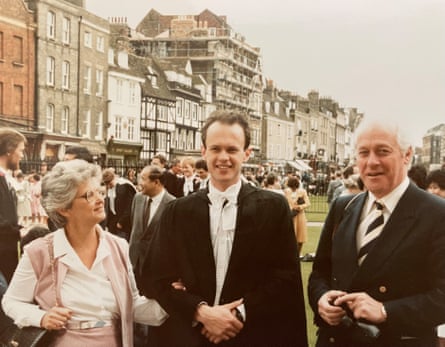
It didn’t miraculously alleviate his guilt. “But an important part of it had been relieved. I’m not trying to say I had a right not to feel guilty any more. All I’m doing is reflecting on how the psychology of it works, how what people do within relationships or social interaction affects how we feel.”
He writes that in the first few weeks after the accident, he couldn’t imagine ever escaping the weight of his remorse, but that forgiveness, particularly from the survivors of the accident, was absolutely key to being able to live a good life. “I was incredibly lucky, because if that had not happened, then there’s no question that guilt would have lingered for much longer and probably still would be affecting me significantly today.”
It did shape his life, and the research and work he would go on to do, including this book. Of the four friends in that car, two have since died. Moore is in touch occasionally with the other one, and offered him the chance to read a draft of his book; he declined. “He’s left it behind. For him it hasn’t, perhaps, stayed with him in the same way it stayed with me.”
Freud’s theory of guilt is that it starts in early childhood, based on a fear of losing the love of one’s caregiver, and that conscience develops as a self-punishing way of controlling one’s behaviour. In the mid-90s, Moore read a paper by the US social psychologist Roy Baumeister, who suggested guilt is the result of damaging a relationship (not, as once thought, about breaking the moral codes either of society or our conscience) and of empathy for another’s distress. This informed Moore’s own thinking.
As parents, we can encourage our children to have a healthier relationship to guilt by encouraging empathy. “This approach uses what we sometimes call guilt induction,” says Moore (what many of us might think of as a “guilt trip”). “Imagine a child has done something mean to a playmate, and the parent says: ‘Look how you made Johnny feel, look how you made Johnny cry.’ You’re trying to induce that empathic side of guilt, to help the child recognise that what they did was probably wrong and that they should attempt some form of repair.” If the parent punishes the child instead, “that makes them feel bad about themselves, [think] they’re a bad person, and the argument is that’s going to be less conducive to repairing relationships”.
Guilt doesn’t mean you’re a bad parent. It just means you’re sensitive to your child’s needs
When does a guilt trip become damaging? “The question is whether you’re doing it for learning purposes versus trying to control the behaviour and trying to get more attention on you.” When children become teenagers, the danger can be that parents use guilt trips “to promote conformity to their own wishes and family ideals. That may be overtly troublesome in that there is tension and conflict, or the child conforms, but has more deep-seated issues.”
Is parenting guilt inevitable? “I think it’s close to inevitable,” says Moore. “That doesn’t mean it has to be damaging, it just means you’re likely to feel it. Keep in mind that I’m thinking of guilt through the lens that it’s a positive emotion. It feels bad, but it’s good for you. You feel guilt as a parent because you want the best for your child, but it needs to be in the right dose. One of the problems is that parents, particularly mothers, are bombarded with all the things that could go wrong – whether they don’t breastfeed, too much screen time, all of the ways in which you parent.” Being a working parent is likely to create guilt. “It doesn’t mean you’re a bad parent. It just means you’re sensitive to the needs of your child. That’s why guilt arises, not because you’re doing a bad job.” People with pets, especially those with dogs, appear to experience similar parental guilt.